


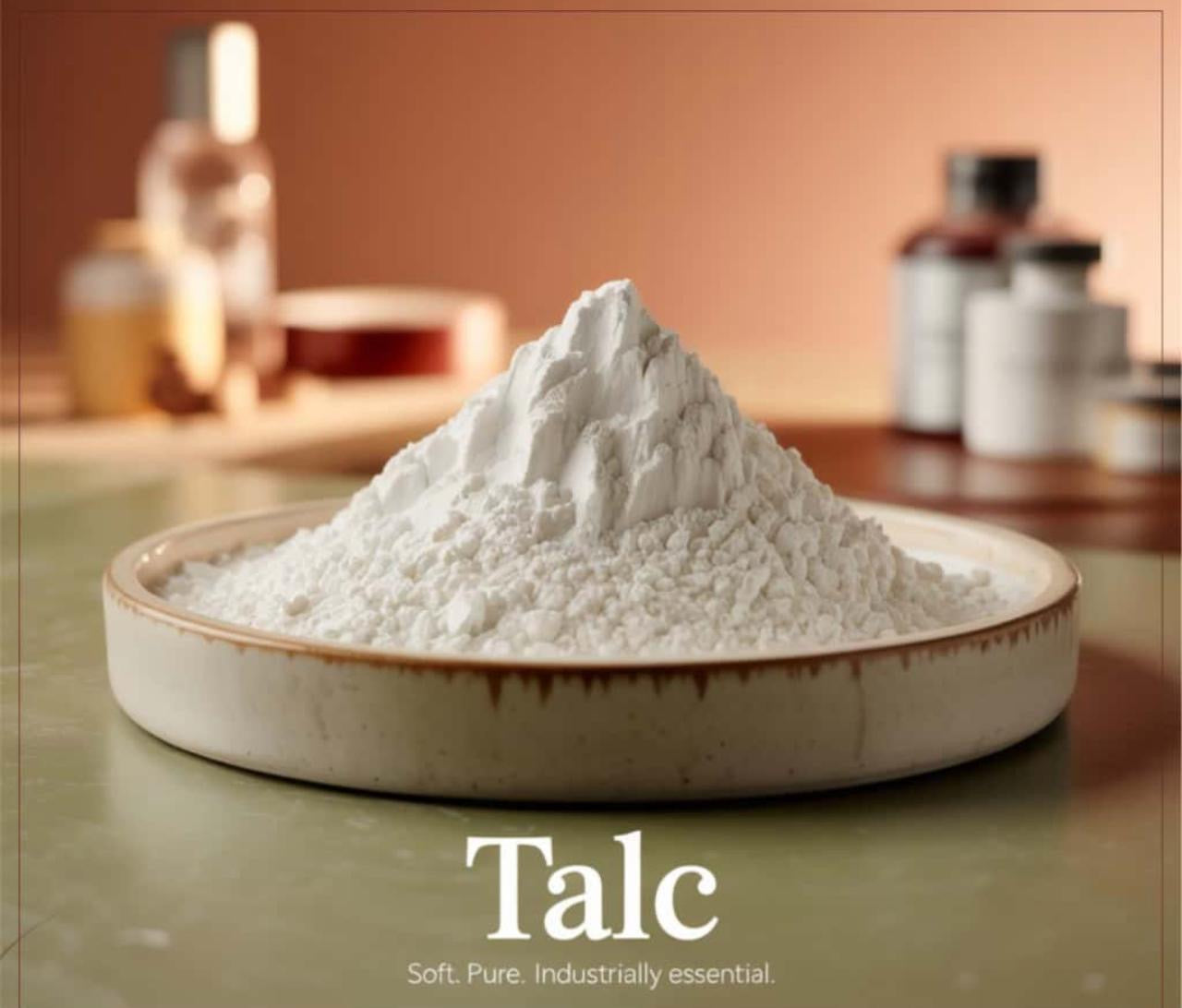
Talc as a High-Performance Industrial Material: Strategic Evolution in the UAE and GCC Markets
Talc is a hydrated magnesium silicate characterised by its lamellar platelet structure, chemical inertness, hydrophobicity, thermal stability, softness, and low abrasiveness. These intrinsic properties underpin its wide industrial relevance. In the UAE and wider GCC, talc is transitioning from a conventional industrial mineral into a strategic functional material, aligned with regional priorities in construction, polymers, coatings, packaging, pharmaceuticals, and advanced manufacturing.
The UAE’s emphasis on high-performance materials, import substitution, sustainability, and regulatory alignment with international standards is reshaping talc demand. Rather than volume-driven consumption, the market is increasingly focused on high-purity, application-engineered grades that deliver measurable performance, compliance, and lifecycle value.
Regulatory Pressures, Purity Standards, and Market Access
Asbestos contamination remains the most critical compliance risk in talc markets globally and is equally decisive in the UAE. While the UAE does not maintain an independent talc-specific asbestos regime, regulatory frameworks are aligned with EU REACH, US FDA, ISO, and Codex Alimentarius standards, particularly for cosmetics, pharmaceuticals, food-contact materials, and personal care products.
Authorities such as MoIAT (Ministry of Industry and Advanced Technology), ESMA, and Dubai Municipality increasingly require:
-
Zero asbestos tolerance
-
Independent third-party mineralogical testing (PLM, TEM, XRD)
-
Full traceability from mine to finished product
-
Transparent documentation for import clearance and downstream use
In the UAE’s role as a re-export and regional distribution hub, compliance failures have amplified consequences. Talc producers capable of consistently supplying asbestos-free material with minimal beneficiation will dominate premium applications. Lower-grade or contaminated deposits will be restricted to indirect-contact industrial uses, such as construction fillers or certain technical ceramics, where regulatory scrutiny is lower but margins are also reduced.
Polymer Engineering and Plastics Manufacturing
The UAE is a major polymer processing and compounding hub, serving automotive components, consumer goods, appliances, and infrastructure-related plastics across the Middle East and Africa. In polymer systems, talc functions as a reinforcing and nucleating filler, enhancing stiffness, dimensional stability, scratch resistance, and heat deflection temperature without a significant weight penalty.
Talc-reinforced polypropylene and polyamide are increasingly used in:
-
Automotive interior and under-the-hood components
-
Electrical housings and appliances
-
Infrastructure-related plastic products exposed to heat and UV
Advances in micronisation, particle size control, and surface treatment—including silane- and titanate-modified talc—have significantly improved dispersion and polymer-filler bonding. These innovations allow talc to partially replace glass fibre in non-structural, high-stiffness components, offering cost, weight, and recyclability advantages that align with regional sustainability goals.
Coatings and Paints in Extreme Climate Conditions
The UAE’s climate—high UV exposure, humidity, salinity, and temperature fluctuations—creates demanding performance requirements for coatings. Talc’s role in coatings is evolving from a low-cost extender pigment to a functional performance enhancer.
High-purity, ultra-fine talc grades contribute to:
-
Improved rheology and sag resistance
-
Reduced cracking and syneresis
-
Enhanced barrier properties against moisture, salts, and chemicals
In architectural, marine, industrial, and protective coatings, talc platelets create tortuous paths that slow water and ion penetration, supporting corrosion resistance in coastal and offshore environments. Hydrophobic talc variants are particularly valuable in high-humidity and coastal applications common across the UAE.
Ceramics, Tiles, and Refractories for Energy Efficiency
The UAE’s construction sector and regional tile manufacturing industry rely heavily on energy efficiency and dimensional precision. Talc acts as a flux in ceramic formulations, lowering firing temperatures and reducing energy consumption—an increasingly important factor as manufacturers seek to control costs and emissions.
In ceramic tiles and sanitaryware, talc:
-
Improves firing consistency
-
Enhances shrinkage control
-
Supports large-format and thin-tile production
In refractories, high-purity talc delivers thermal shock resistance and chemical stability, making it suitable for glass furnaces, metallurgical vessels, and industrial kilns subjected to repeated high-temperature cycles. These properties align with the UAE’s glass, aluminium, and steel processing industries.
Functional Paper, Packaging, and Food-Contact Materials
While traditional printing paper demand is declining, talc’s relevance in the UAE is expanding in functional packaging and food-contact applications. The region’s logistics, food processing, and export sectors require packaging solutions that meet strict safety and performance standards.
Talc continues to serve as a pitch control agent in pulp processing, but its strategic value lies in:
-
Barrier coatings for food packaging
-
Grease and moisture resistance enhancement
-
PFAS-free alternatives for food-contact paper
When combined with other minerals, talc supports compliance with FDA, EU food-contact, and GCC standards, positioning it as a key component in sustainable and biodegradable packaging systems increasingly demanded by regulators and consumers.
Cosmetics and Personal Care Under Heightened Scrutiny
The UAE is a major cosmetics import, manufacturing, and re-export market. Talc’s tactile properties—softness, absorbency, lubricity—remain highly valued in pressed powders, foundations, blushes, and dry personal care products.
However, regulatory scrutiny and consumer awareness require:
-
Absolute assurance of zero asbestos content
-
Independent laboratory certification
-
Transparent documentation for product registration
Premium cosmetic-grade talc will remain viable in the UAE, particularly when positioned within hybrid formulations that combine talc with starches, silica, or mica to optimise texture while maintaining compliance and consumer trust.
Pharmaceutical and Nutraceutical Applications
The UAE’s pharmaceutical and nutraceutical sectors demand exceptional purity and particle size control. Talc is widely used as:
-
A glidant and anti-caking agent in tablet production
-
A moisture barrier in sensitive formulations
Its hydrophobic nature is also being explored for controlled-release systems, supporting advanced drug delivery research. In nutraceutical powders and functional foods, talc’s chemical inertness ensures stability without interfering with active ingredients—an important factor in high-temperature and high-humidity storage conditions common in the region.
Environmental Technologies and Sustainable Materials
Environmental applications are gaining relevance as the UAE invests in water security and sustainability. Modified talc is under investigation as an adsorbent for organic contaminants and heavy metals in water treatment systems. Surface functionalisation improves affinity for pollutants, enabling use in filtration and remediation media.
In bio-based polymers such as PLA, talc functions as a nucleating agent, improving crystallinity, mechanical strength, and thermal performance—supporting the UAE’s growing interest in sustainable materials and circular economy initiatives.
Additive Manufacturing and Advanced Materials
Additive manufacturing is emerging within the UAE’s advanced manufacturing ecosystem. Talc is being evaluated for use in binder jetting and powder-based composite systems, where its morphology and thermal stability could enhance surface finish and dimensional control.
Commercial adoption will depend on achieving:
-
Consistent particle size distribution
-
Adequate flowability
-
Compatibility with existing 3D printing process parameters
Sustainability, Local Processing, and Industrial Strategy
Reducing the environmental footprint of talc production aligns with the UAE’s industrial strategy. Key levers include:
-
Dry beneficiation processes to reduce water usage
-
Advanced ore sorting to selectively extract high-purity material
-
Improved logistics and regional processing to reduce transport emissions
Recovery of secondary minerals from tailings can improve mine economics while supporting environmental compliance and waste reduction.
Strategic Outlook for the UAE Market
In the UAE, talc’s future growth will be driven by value-added, application-specific, and compliance-certified products, not bulk commodity supply. Producers and distributors that integrate mineral science with customer product development—acting as technical partners rather than raw material vendors—will secure premium positioning.
Market success will increasingly depend on:
-
Functional performance validation
-
Regulatory assurance across multiple jurisdictions
-
Sustainability credentials aligned with regional policy goals
The UAE market will reward engineered talc solutions that deliver reliability, safety, and performance in demanding environments, reinforcing talc’s role as a strategic industrial material rather than a low-margin filler.


